
How to exhibit at a trade show : the ultimate step-by-step guide for 2026
What you will learn
How to plan and prepare for exhibiting at a trade show from six months out
How to choose the right event based on audience, ROI potential, and logistics
How to design a booth that attracts visitors and communicates your brand instantly
What your staff needs to know before they step on the show floor
The best strategies to engage attendees and generate qualified leads
How to follow up after the show and measure your return on investment
Why exhibiting at a trade show is still worth it
Trade shows occupy a unique position in the marketing mix. No digital channel replicates the impact of a face-to-face interaction where a prospect can see, touch, and experience your product in real time. For brands serious about growth, exhibition is not optional it is one of the highest-converting environments available.
The key benefits of exhibiting at a trade show include:
Direct access to a concentrated, pre-qualified audience actively looking for solutions
Immediate feedback on products, pricing, and positioning
Accelerated relationship-building that would take months through digital outreach
Brand visibility among industry peers, press, and potential partners
Lead generation in volumes that are difficult to replicate through any other single channel
Trade shows are a long game. Your first event may not generate a flood of immediate orders, but the contacts you build and the brand impressions you create compound over time into lasting commercial relationships.
📸 Recommended image: wide shot of a busy trade show floor showing multiple branded booths with high foot traffic and visitors engaging with exhibitors
Step 1: choose the right trade show
Not all trade shows deliver equal value. Selecting the wrong event is one of the most expensive mistakes an exhibitor can make, so research thoroughly before committing budget.
Evaluate each event against your business goals
Before shortlisting events, define what success looks like for your brand. Are you launching a new product? Targeting a specific buyer profile? Expanding into a new market? Each goal points to a different type of event.
Use this framework to compare your options:
Evaluation criteria | What to look for |
Industry relevance | Does the show attract your exact target audience? |
Attendee demographics | Does the buyer profile match your ideal client? |
Attendance figures | Are numbers growing year over year? |
Competitor presence | Do leading brands in your space exhibit here? |
Cost vs expected ROI | Does the investment align with your conversion potential? |
Location and logistics | Can your team get there efficiently with full booth materials? |
Past exhibitor reviews | What do previous exhibitors say about lead quality and organization? |
The above criteria serve as a general evaluation framework. Results will vary depending on your industry, booth investment, and event conditions.
Whenever possible, attend the event as a visitor before committing to exhibit. Walk the floor, speak to exhibitors, and observe what draws visitors in. You will learn more in one day on-site than in hours of online research.
Step 2: plan your budget with full transparency
Budget planning is where many exhibitors underperform. The booth fee is just the beginning. A realistic budget must account for every cost category to avoid surprises.
Budget category | What it covers | Typical cost range |
Booth space fee | Floor space reservation at the event | $1,500 to $15,000+ |
Booth design and build | Custom or modular structure, graphics, and finishes | $5,000 to $100,000+ |
Trade show booth graphics | Large-format printing, banners, and branded panels | $500 to $5,000 |
Lighting and AV equipment | LED rigs, screens, and audio systems | $500 to $8,000 |
Furniture and accessories | Counters, chairs, display fixtures, and storage | $300 to $3,000 |
Shipping and logistics | Transport, handling, and on-site delivery | $500 to $5,000 |
Staff costs | Travel, accommodation, and per diems | $1,000 to $10,000 |
Pre-show marketing | Social ads, email campaigns, and print materials | $500 to $5,000 |
Miscellaneous | Repairs, last-minute supplies, and contingency | 10 to 15% of total |
All figures are provided for informational purposes only and represent average market estimates. Actual costs vary significantly depending on event location, booth size, and supplier pricing.
A clear budget protects your ROI calculation from day one. If exhibiting costs $30,000 in total, you need to know how many leads, contracts, or brand outcomes justify that figure before you even arrive on-site.
📸 Recommended image: close-up of an exhibitor reviewing a budget spreadsheet and event checklist on a laptop
Step 3: design a booth that stops people in their tracks
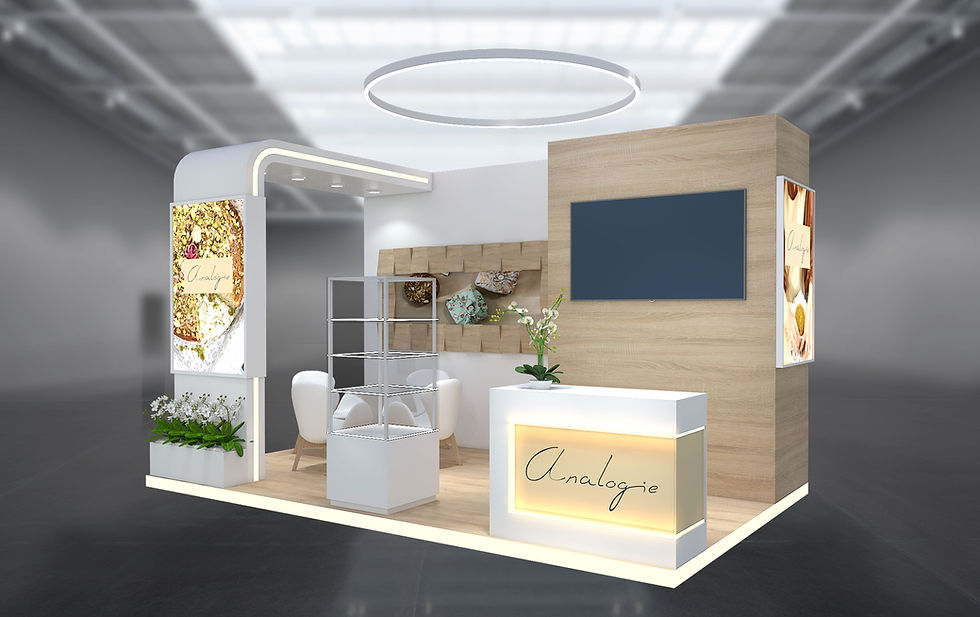
Your booth design is your single most powerful conversion tool on the show floor. Before an attendee hears a word from your team, they have already formed an impression based entirely on what they see.
The non-negotiables of effective booth design
Every high-performing booth shares these core characteristics:
A bold, clear visual identity that communicates your brand in under three seconds
A single dominant message displayed at or above eye level, readable from 5 meters away
An open, welcoming layout with no furniture barriers blocking the entrance
Professional trade show booth graphics printed at high resolution with accurate brand colors
Strategic lighting to draw the eye, highlight products, and create a premium atmosphere
For a deeper look at visual strategy, read our guide on how to make your trade show booth stand out.
Choose the right booth type for your brand
The structure you choose should reflect your brand positioning and event ambitions:
Custom booths are designed and built entirely around your brand, delivering maximum visual impact and full control over every material, finish, and detail. They are the preferred choice for high-end brands participating in flagship events.
Modular booths offer flexibility and reusability across multiple events, with components that can be reconfigured and updated without replacing the entire structure.
Pop-up and portable displays are lightweight entry-level options suited to smaller spaces or occasional exhibitors with tighter budgets.
For brands operating at the premium end of their market, a generic or low-budget booth sends entirely the wrong signal. Your booth is a physical representation of your product quality and company standards. Our trade show booth design services are built specifically for brands that refuse to compromise on presence.
Make your booth interactive
Passive booths lose visitors to more engaging neighbors. Adding interactive dimensions dramatically increases dwell time and lead quality. Consider:
Live product demonstrations running on a schedule
Touchscreen product configurators or digital catalogs
Photo opportunities with branded backdrops
Short in-booth presentations or expert talks
Discover proven techniques on how to make your trade show booth more interactive and increase visitor engagement from the moment they step inside.
Work with experienced professionals
Designing a high-impact booth requires expertise in visitor psychology, spatial design, and materials. Partnering with exhibition stand companies that specialize in custom builds ensures your concept is executed flawlessly from concept to installation.
📸 Recommended image: interior view of a high-end custom booth with LED lighting, branded panels, and a staff member engaging a visitor during a live demo
Step 4: prepare and train your team
Your booth design attracts visitors. Your team converts them. Staff preparation is one of the most overlooked investments in trade show planning, and one of the highest-return ones.
Brief your team thoroughly
Every team member on the booth should know:
Your core brand message and value proposition by heart
The top three questions visitors are likely to ask, and the answers
How to open a conversation naturally without being aggressive
How to qualify a lead quickly using two or three targeted questions
The lead capture process and tools being used at the event
Train for real scenarios
Role-playing customer interactions before the show builds confidence and consistency. Practice these common scenarios:
A visitor who stops briefly and needs to be drawn into a fuller conversation
A technically minded prospect asking detailed product questions
A skeptical attendee who has already visited three competitors
A rushed buyer who wants the core message in thirty seconds
The goal is not a scripted pitch but a natural, informed conversation that feels genuine and builds trust instantly.
Manage energy across the show days
Trade shows are physically and mentally demanding. Exhibiting for eight or more hours across multiple days depletes even experienced teams. Plan shift rotations where possible, ensure team members eat and hydrate consistently, and hold brief daily briefings each morning to align goals and energy.
Step 5: promote your participation before and during the event
Marketing your presence is as important as designing your booth. The exhibitors who fill their diaries with appointments before the show opens consistently outperform those who rely solely on walk-in traffic.
Pre-show marketing actions
Starting four to six weeks before the event:
Announce your participation on LinkedIn, Instagram, and any relevant industry platforms
Send personalized emails to existing clients and warm prospects inviting them to visit
Complete your exhibitor profile on the event website in full buyers use these to plan their visit
Tease product launches or exclusive reveals to generate anticipation
Use the official event hashtag to enter the conversation early and gain organic visibility
On-site visibility tactics
Once the show is open:
Display your booth number prominently on all digital and print communications
Use QR codes linking to your website, product pages, or a lead capture form
Announce scheduled demos or presentations on your social channels in real time
Encourage visitors to tag your booth in their own event content
If you are exhibiting in a major American city, explore our article on trade show booths in New York for location-specific insights and vendor recommendations.
📸 Recommended image: exhibitor sharing a social media post at their booth during a live event, phone in hand with branded backdrop behind them
Step 6: capture leads and engage visitors effectively
Generating leads at a trade show requires both the right tools and the right attitude. Every visitor who enters your booth is a potential relationship treat each interaction accordingly.
Use digital lead capture
Paper forms and business card piles get lost. Use tablet-based forms, badge scanning apps, or dedicated lead capture software to collect visitor information instantly. Tag leads with context notes immediately after each conversation while details are fresh.
Qualify as you go
Not every visitor is a qualified lead. Train your team to ask two or three qualifying questions early in each conversation to assess fit and priority level. This helps you focus post-show follow-up energy where it will deliver the best results.
Offer genuine value
Give visitors a reason to remember you specifically. The best trade show exhibiting tips consistently point to the same principle: offer something useful, not just promotional. A free insight, a personalized recommendation, or an exclusive preview of an upcoming product creates a more lasting impression than a branded pen.
Step 7: follow up and measure your results
The trade show floor is where impressions are made. The weeks that follow are where ROI is actually generated.
Follow up within 48 hours
Send personalized emails to every qualified lead within 48 hours of meeting them. Reference the specific conversation or product they showed interest in. Attach a relevant case study, product sheet, or proposal. Speed and personalization signal professionalism and keep your brand top of mind before competitors reach out.
Measure performance against your goals
Review every objective you set in Step 1 and score your performance honestly:
Success metric | Target set | Result achieved | Next step |
Qualified leads generated | 100 | Actual number | Nurture via CRM |
Meetings booked on-site | 20 | Actual number | Convert to proposals |
Social media mentions | 50 | Actual number | Amplify best content |
Press or media coverage | 2 articles | Actual number | Send follow-up pitches |
Post-show conversions | 15% of leads | Actual rate | Refine follow-up sequence |
The above targets are illustrative examples. Define your own benchmarks based on your specific business objectives and historical event performance.
Debrief and improve
Hold a team debrief within one week of the event. Document what worked, what underperformed, and what you would do differently. This institutional knowledge compounds over time and makes each successive trade show more efficient and more profitable than the last.
📸 Recommended image: team gathered around a conference table reviewing post-show analytics on a screen, whiteboard notes visible in the background
The complete trade show exhibitor checklist
Six months before
Select the event and reserve booth space
Define measurable goals and allocate full budget
Brief your booth design team and begin concept development
Three months before
Finalize booth design, materials, and graphics
Confirm shipping and logistics providers
Launch pre-show marketing campaigns
One month before
Train all booth staff on messaging, product knowledge, and lead capture
Confirm all shipments, badges, and installation schedules
Prepare printed and digital materials including brochures and QR codes
One week before
Pack all booth materials with detailed inventory lists
Verify transport arrangements and on-site installation timing
Brief team on daily schedule, shift rotations, and booth objectives
After the show
Send personalized follow-up emails within 48 hours
Update CRM with all lead data and conversation notes
Hold team debrief and document improvements for next event
What to remember
Success at a trade show begins months before the event with clear goals, a realistic budget, and professional booth design
Your booth is your brand's physical handshake it must reflect the quality and ambition of your company
Staff preparation and genuine visitor engagement convert impressions into qualified leads
Pre-show marketing fills your calendar before the doors open and maximizes walk-in traffic during the event
Following up within 48 hours with personalized messages is the single highest-impact post-show action you can take
Measure every result against your original objectives, debrief honestly, and apply those learnings to every future event
FAQ - how to exhibit at a trade show
What is the best way to prepare for exhibiting at a trade show for the first time?
Start planning at least six months before the event. Define clear goals, establish a full budget including all hidden costs, select a booth design that reflects your brand positioning, and train your team thoroughly before the show opens. Early preparation eliminates the majority of first-time exhibitor mistakes.
How much does it cost to exhibit at a trade show?
Total costs vary widely depending on booth size, design level, and event location. A basic setup can start around $3,000 to $5,000 while a fully custom premium booth for a major international show can exceed $100,000 when all costs including graphics, shipping, lighting, and staffing are included.
How do I attract more visitors to my trade show booth?
Invest in a visually bold booth design with strong lighting and clear messaging. Train your team to engage proactively rather than waiting for visitors to approach. Add interactive elements such as live demos or digital experiences, and promote your booth number and schedule on social media before and during the event.
What are the most effective trade show marketing strategies?
Combine pre-show digital outreach with on-site visibility tactics. Announce your participation on LinkedIn and email, complete your exhibitor profile on the event website, use QR codes and live social content during the show, and follow up immediately after with personalized messages to every qualified contact.
What should I include in a trade show exhibitor checklist?
A complete checklist covers six months of preparation milestones including booth design sign-off, logistics confirmation, staff training, pre-show marketing, on-site setup, daily operations, lead capture, and post-show follow-up. Adapt it to your specific event scale and team size.
How do I measure the ROI of exhibiting at a trade show?
Track metrics tied to your original goals including qualified leads generated, meetings booked, post-show conversion rates, social media reach, and any press coverage obtained. Use a CRM to monitor lead progression over the following weeks and calculate total return against your full event budget.
Comments